Cultures & Expatriations​

Results of survey 3: What is it like to live abroad on a day-to-day basis?

Results of survey 3: What is it like to live abroad on a day-to-day basis?

To celebrate its 10th anniversary, the Expat Communication Barometer has broadened the scope of its expatriation survey to provide a detailed portrait of expatriates’ daily lives in 2024. After examining the motivations for expatriation in February and the lessons learnt from the experience in April, this third section focuses on the choices and habits of expatriates in their daily lives abroad.

The survey explores themes such as satisfaction with the living environment, the impact of expatriation on purchasing power, changes in media consumption and mobility patterns, and educational decisions for children. It also looks at topical issues such as the Olympic Games and the legislative elections in France.

Carried out among 2,564 participants between 5 July and 5 August 2024, this study provides a solid basis for multiple analyses, and distinguishes six expatriate profiles: transferred expatriates, spouses, expatriates on local contracts, adventurers without contracts, retirees and students. The Barometer highlights changes over time and reveals new trends.

Five strategic partners – April, Banque de France, Caisse des Français de l’étranger (CFE), Carrefour and Globeducate – are taking part in this survey, which provides a unique and comprehensive picture of expatriation, enriching our understanding of the contemporary challenges of life abroad.

A big thank you to all the expats who participated in this survey, our media partners who relayed the survey to their networks, and our Board members who contributed to the excellence of this project.

The demographic profile of participants remains consistent with that of the previous survey, particularly in terms of gender distribution. The most represented age group is 60 and over. Of the respondents, 47% of men and 53% of women were aged between 30 and 39. The majority of participants (64%) are in a couple. The composition of the panel reflects a strong French presence (81% of respondents). More than half (57%) have children.

Expatriation, a growing source of well-being?

According to the results of our survey, expatriate morale is high, with an average level of 73 on a scale of 1 to 100, a significant improvement on last year’s level of 65.

Retired employees scored the highest, with an average morale of 75, up 2 points on the previous year. Employees on local contracts follow closely behind, with an equally high score of 73.

On the other hand, ‘adventurers’ and ‘spouses’ show more moderate, but still positive, levels of morale, with average morale of 68 and 67 respectively. These figures suggest a generally positive climate.

A significant rebound in purchasing power, but challenges remain.

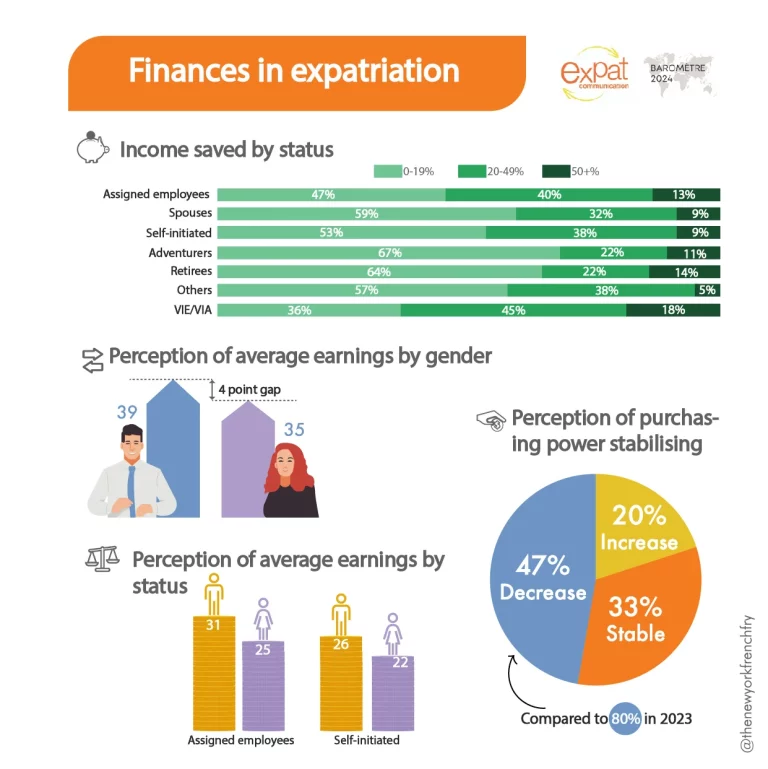
The gender pay gap, a recurring theme in discussions on professional equality, is still very much on the agenda. Women continue to perceive a pay gap with men, particularly among spouses, seconded employees and those on local contracts. With a perceived pay gap of up to 4 points, this situation highlights the specific challenges faced by expatriate women, particularly in terms of pay and career development.

In 2024, expatriates report a clear improvement in their purchasing power compared to the previous year, with a significant drop in the percentage who consider their purchasing power to be low or very low, from 80% to 47%. This is particularly encouraging in a global context of inflation and economic uncertainty. However, despite this improvement, expatriates appear to be constrained in their ability to save, with 26% limiting their savings to less than 10% of their income.

Barometre septembre 2024

The education of expatriate children: between tradition and globalisation

Barometre septembre 2024

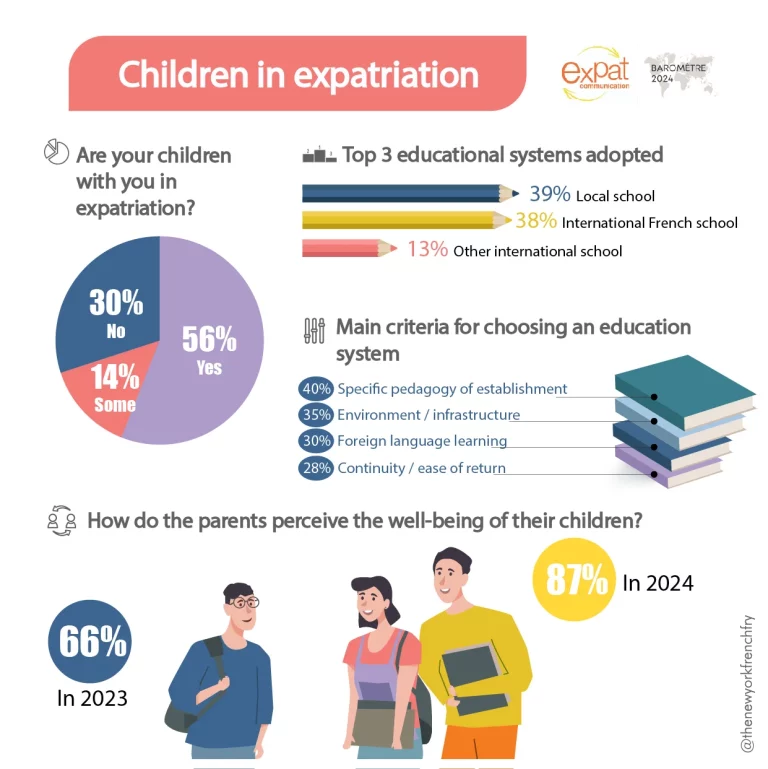
Expatriate parents, representing 57% of our panel, are faced with a real educational dilemma for their children. Split between various options – local schools, international French establishments or other international institutions – they have to reconcile cultural roots and preparation for a globalised world.

Their priorities are clear: the school’s teaching comes top (40%), followed closely by the quality of the infrastructure (35%) and language learning (30%). This subtle balance shows their desire to offer their children an education that is both solid and internationally-minded.

However, this choice is not without its challenges. Indeed, 16% of expatriate children have experienced bullying at school, a figure higher than the French average (between 6% and 10% depending on the level). This statistic raises questions about the integration of expatriate children in their host schools.

Despite this, it is reassuring to note that 87% of parents feel that their children are thriving in their expatriate experience.

Over and above decisions about schooling, these results call for a broader reflection on the way in which expatriation shapes children’s educational experience. Between passing on family values and adapting to a new environment, parents are navigating a complex context in search of the right balance for their children’s development.

Expatriate media: from national roots to international openness

There is a strong and persistent attachment among expatriates to news from their country of origin. Indeed, 83% of them continue to follow the news, mainly via the online press (67%), social networks (58%) and television (51%).


However, an interesting trend is emerging over the years. After 16 years of expatriation, there has been a change in this dynamic: following international news has increased by around 30%.

This shift highlights a gradual transition among long-term expatriates towards a more global view of the world. Despite this, cultural and national roots remain a priority for many, as evidenced by the continued high level of home country news coverage.

Baromètre 2024 septembre

Political commitment and the impact of the Olympic Games

Barometre septembre 2024

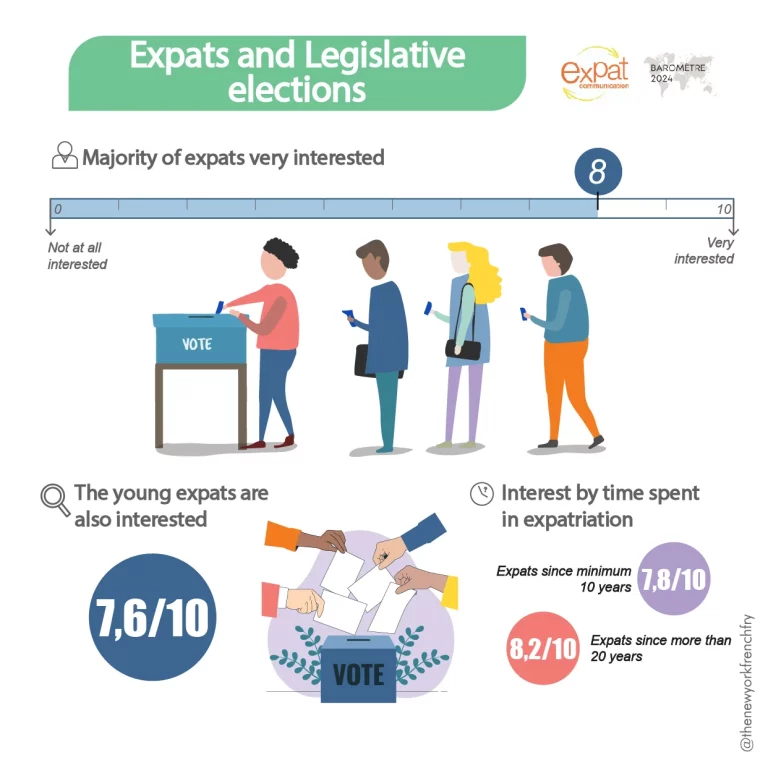
54% of expatriates showed a keen interest in the French parliamentary elections, particularly among 18-29 year-olds and the over-50s. The average level of interest is 8 on a scale of 0 to 10, which is extremely high.

As for the Paris Olympics, they had a moderate impact. And 42% of expatriates had planned to follow the Games, via the online press (65%), social networks (57%) and TV (54%).

Membres du Baromètre de la communication des expatriés.

Those who relay the Expat Communication Barometer.

Next survey on “Expat life” from July 5 to August 5, 2024.

radio for French people around the world stereochic Expat Communication

Catherine Talec presents the results of the Expat Communication Barometer:
June 2024

About Expat Communication

Since 2001, Expat Communication has been preparing and supporting its clients’ expatriates and international teams.

Its mission: to identify and share the keys to a successful international experience through three business lines:

  • Expat Lab: benchmark studies on expatriates and international mobility. Barometer, conferences, masterclasses and publications.
  • Coaching and training: programmes to facilitate expatriation and strengthen employees’ intercultural intelligence, all over the world in 8 languages. These programmes are run by a network of trained and supervised intercultural coaches.
  • Expat Network: Club Expat Premium and the femmexpat.com website support more than 40,000 expatriates worldwide.

Join our panel

If you would like to have access to the infographics and survey results, join the Barometer Board or contact us via the link below for more information:

Follow-us

Request a quote

Please fill out the form below, or contact us directly at +33 (0)1 42 3 691 91 or by email at contact@expatcommunication.com

Your IM Manager

To join our team

Please fill out the form below, or contact us directly at +33 (0)1 42 36 91 91 or by email at recrutement@expatcommunication.com


We are at your disposal

from 9am to 6pm (CET) +33 (0)1 42 36 91 91

Write to us

Club Expat Premium subscription request

Please fill out the form below, or contact us directly at +33 (0)1 42 3 691 91 or by email at contact@expatcommunication.com

For each subscription, please indicate the number of expatriates concerned and their contact information (city, country, email + spouse's email if applicable). If you prefer, you can send us an Excel spreadsheet or contact us directly.