Corporate Expatriation: Employees and Partners, How Do You Experience the Challenges of Mobility?
A study conducted by Expat Communication, in partnership with Carrefour and Alstom.
This fourth edition of the 2025 Barometer provides a detailed look at the day-to-day reality of corporate expatriates. Expat Communication collected insights from more than 1,000 expatriates, half of them French and half from a wide variety of nationalities. Nearly 3,000 verbatim comments offer a concrete, nuanced and finely grained understanding of their experience.
The analysis highlights their perceptions, needs and the conditions that shape their personal and professional balance.
L’expatriation en entreprise constitue un levier important de développement, mais les résultats montrent qu’elle s’accompagne aussi de défis spécifiques, liés à l’intégration, à l’environnement de travail ou à l’accompagnement familial.
orporate expatriation is a significant driver of development, but the findings also show that it comes with specific challenges related to integration, the working environment and family support. By gathering this rich and detailed material, the study identifies both the strengths and vulnerabilities of the expatriate journey and provides essential elements to help organisations adjust their mobility policies and better support their employees throughout their assignment.
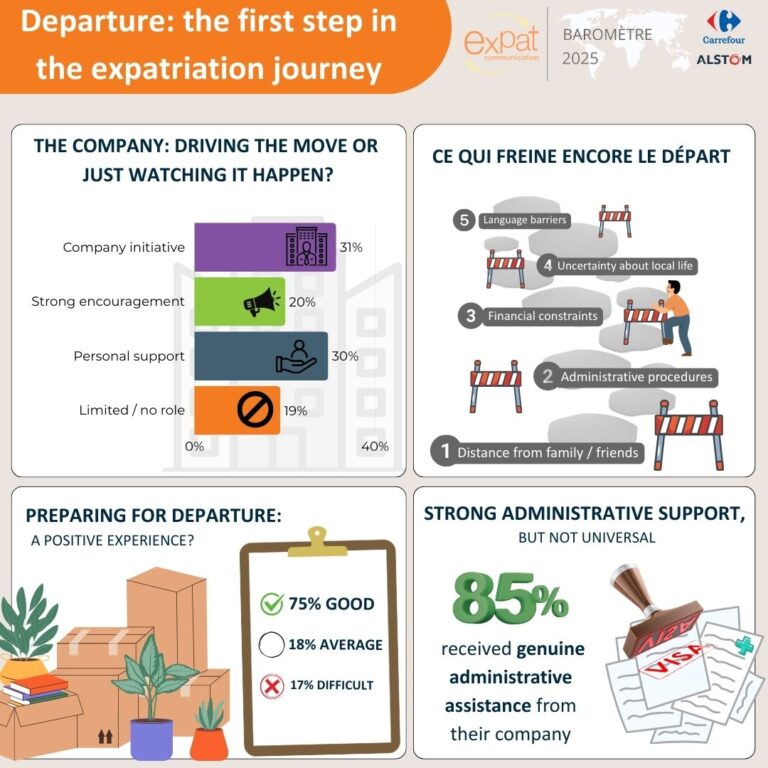
Supporting the departure: essential but uneven assistance
This support is crucial, yet it has limitations. Few programmes include help with schooling or the spouse’s career planning.
Respondents point out that a more comprehensive approach — including the human dimension and not only logistics — would have made the transition easier.
The highly international panel reflects diverse expectations depending on cultures, companies and family situations. This diversity demonstrates the importance of adaptable, differentiated support.
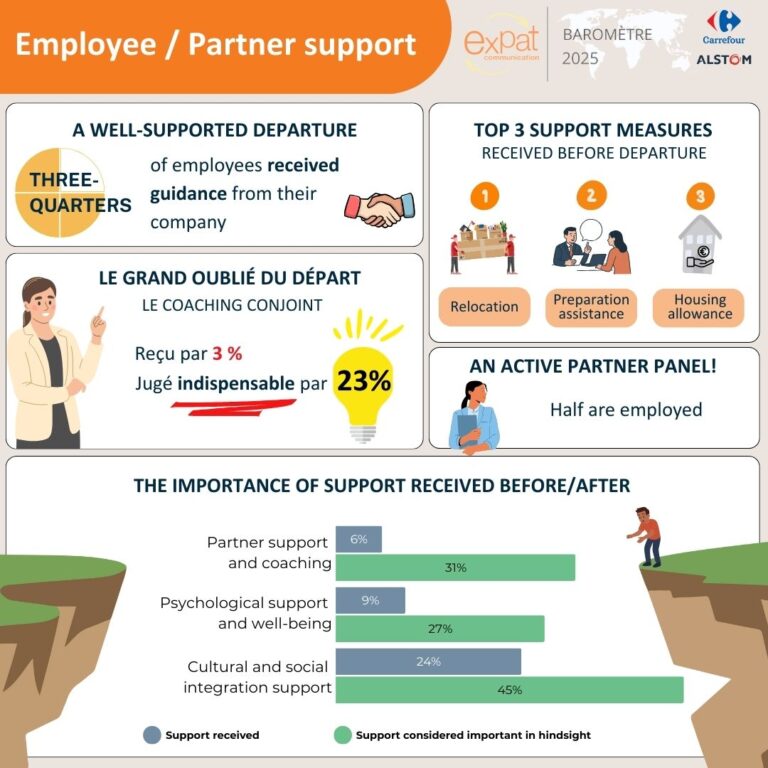
Supporting employees and spouses: a growing need for comprehensive solutions
Once abroad, support decreases significantly.
While 45% of respondents are seconded employees, spouses remain more vulnerable: only 52% are employed in the host country, with a notable gap between men (60%) and women (48%).
This disparity directly affects household balance and is a major factor of vulnerability.
Respondents highlight needs related to:
- cultural integration support,
- job-search assistance,
- emotional support during the adjustment period,
- children’s schooling follow-up.
Experience shows that employee-spouse support programmes, often operational in nature, still struggle to address the issues of career, identity and integration faced by spouses.
The expatriation package: a key lever, but shifting priorities
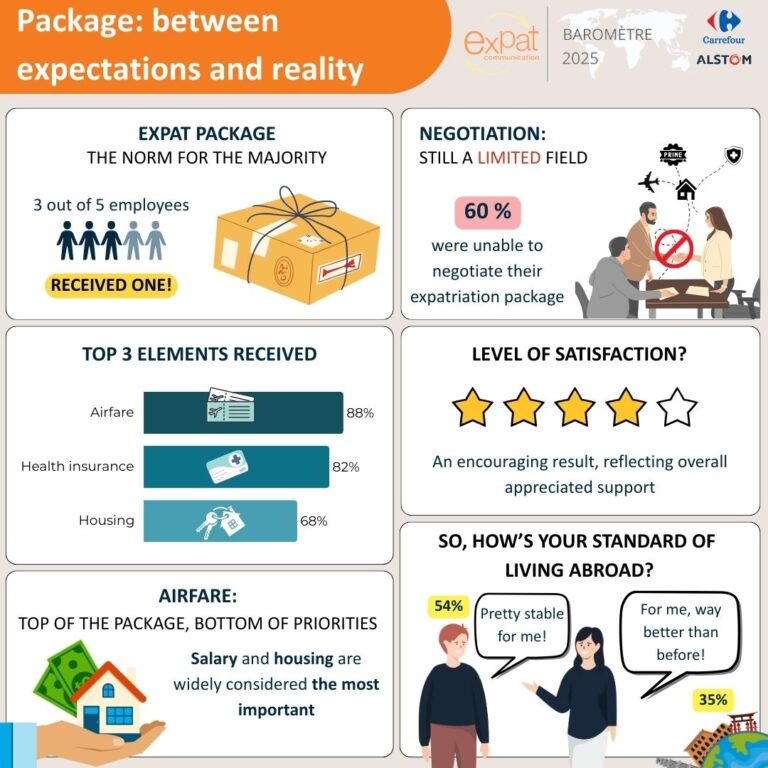
63% of respondents benefit from a package including the most common trio: airfare, health insurance and housing assistance.
Satisfaction reaches 3.9/5, and 40% manage to negotiate its terms, with a slightly higher proportion among women.
However, the findings show that expectations evolve significantly over time.
While these practical elements are essential at the beginning, many expatriates note that, with hindsight, they matter less in the overall success of the experience.
The package remains a structuring element, but expatriates increasingly express the need for more comprehensive support going beyond material aspects.
The impact of expatriation: personal transformation and professional development
Expatriation has a profound impact on individual trajectories, far beyond a simple change of position or country.
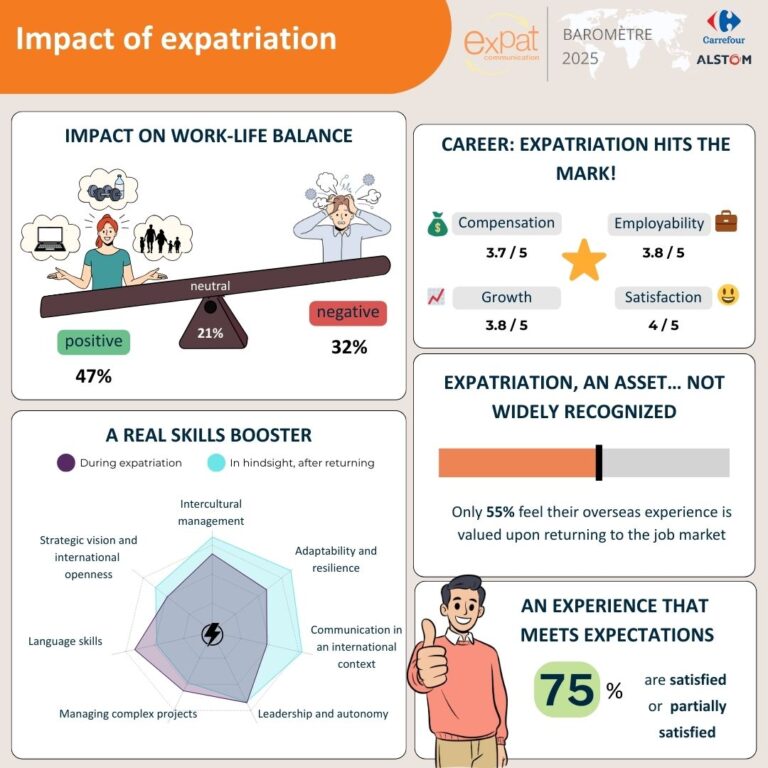
Respondents highlight strong development in key skills: intercultural management, adaptability, autonomy, decision-making and leadership.
Women particularly emphasise strengthened flexibility and ability to manage change — essential skills in unstable or multicultural environments.
Professionally, many expatriates still abroad consider expatriation a career accelerator.
85% believe that the experience met their initial expectations: cultural openness, increased skills, broader responsibilities or hierarchical progression.
The return, often experienced as a separate phase, reveals persistent disparities.
60% of returning expatriates were supported, but gaps remain significant between men (73%) and women (43%).
Career paths after return vary widely: some quickly find their footing, while others must reorient themselves.
According to the data, 34% return to their previous job or a similar position,
while 14% report a period of unemployment or inactivity, and another 14% leave their company or rethink their career path.
Expatriates’ morale: overall optimism, nuanced realities
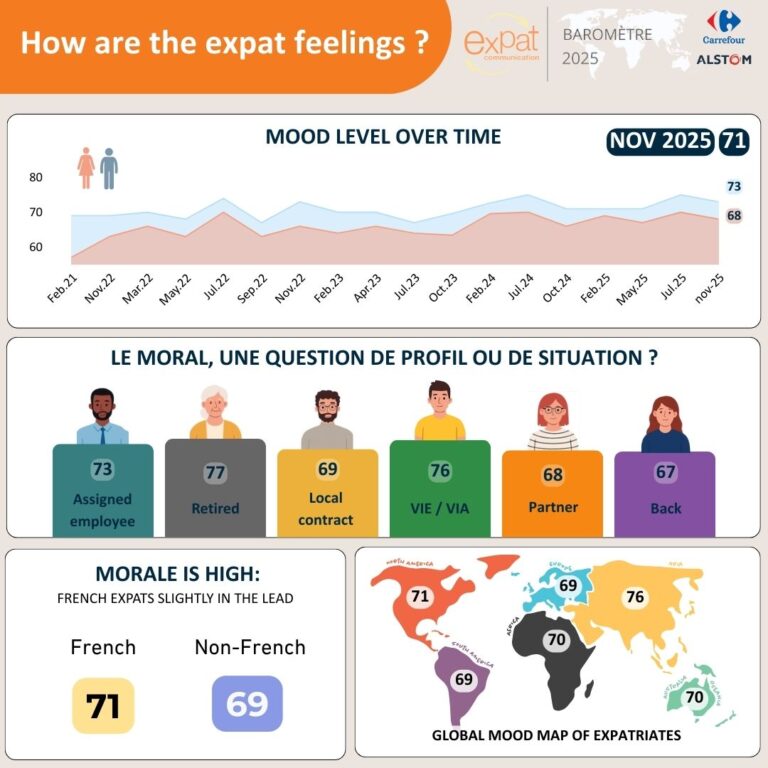
Overall morale stands at 71/100, confirming a trend observed in previous surveys.
However, differences appear between profiles. Men report slightly higher morale than women, with wider gaps among 18-29-year-olds and 50-59-year-olds.
The youngest and the oldest display more optimism, while the 30-49 age group scores slightly lower.
As in every edition, accompanying spouses remain the most fragile group, with the lowest morale in the panel.
Differences also emerge between French and non-French respondents: French expatriates show slightly higher morale, while among non-French respondents, morale increases significantly with age, with the youngest being the least positive.
Some regional disparities also stand out, with French expatriates reporting particularly high morale in Oceania and South America. This diversity highlights how differently expatriation can be experienced depending on role, age, gender and context.
An enriching but demanding experience
The study confirms that expatriation is a largely positive experience, fostering personal and professional growth.
But it also highlights several points of attention: spouse vulnerability, gender inequalities, limited post-arrival support and the complexity of returning.
Overall, the findings underline the need for more comprehensive, continuous and truly personalised support to ensure international mobility remains an opportunity — not a risk.
A particularly revealing testimonial shared by one respondent:
“An often underestimated aspect is mental health support. Living in a new country requires numerous adjustments that overload our brain, and yet we must continue working.”
Members of the Board


Those who relay the Expat Communication Barometer.
Join our panel
If you would like to have access to the infographics and survey results, join the Barometer Board or contact us via the link below for more information:
About Expat Communication
Since 2001, Expat Communication has been preparing and supporting its clients’ expatriates and international teams.
Its mission: to identify and share the keys to a successful international experience through three business lines:
- Expat Lab: benchmark studies on expatriates and international mobility. Barometer, conferences, masterclasses and publications.
- Coaching and training: programmes to facilitate expatriation and strengthen employees’ intercultural intelligence, all over the world in 8 languages. These programmes are run by a network of trained and supervised intercultural coaches.
- Expat Network: Club Expat Premium and the femmexpat.com website support more than 40,000 expatriates worldwide.
Contact:

Albine Horiot
Expat Lab director
albine.horiot@expatcommunication.com

Alix Carnot
Director Expat Communication
alix.carnot@expatcommunication.com