Cultures & Expatriations​

Survey results n°2: What do we learn in expatriation?

Survey results n°2: What do we learn in expatriation?

Expat Communication, an expert in interculturalism and support for international mobility, unveils the results of the second survey of its 2024 Barometer, conducted online among 2428 expatriates, from April 15 to May 10, 2024.

For its tenth anniversary, the Expat communication barometer proposes, through four surveys, to take a “tour of expatriation”, to understand its different facets and to analyse the new drivers of international mobility.

This second survey explores in particular the question of learning in expatriation: how does the view of the country of origin change? How do you train? How does the way of working change?
Some answers below.

As in every survey, a first point on the morale of expatriates

Enquête 2 Baromètre Expat Communication

The level of morale of the panel, surveyed every quarter, stabilised at 71% in April 2024, and as in previous periods, shows a gap of a few points between men and women: at 73% and 68% respectively.

The study also measures morale according to the different expatriation statuses*:
– Retirees are in the lead
with a morale of 73%
– Spouses and adventurers
do not exceed 67%

The April 2024 survey also reveals the impact of returning from expatriation on morale levels, which drops to 64% for returning expatriates or in transit.

As a reminder, the February results had already highlighted the impact of the absence of professional activity on morale. If we combine the two effects, return and active job search, the level of morale drops to 46%.

Expatriation has a lasting influence on the perception of the world and first and foremost on relationships with others

BAROMETER SURVEY 2


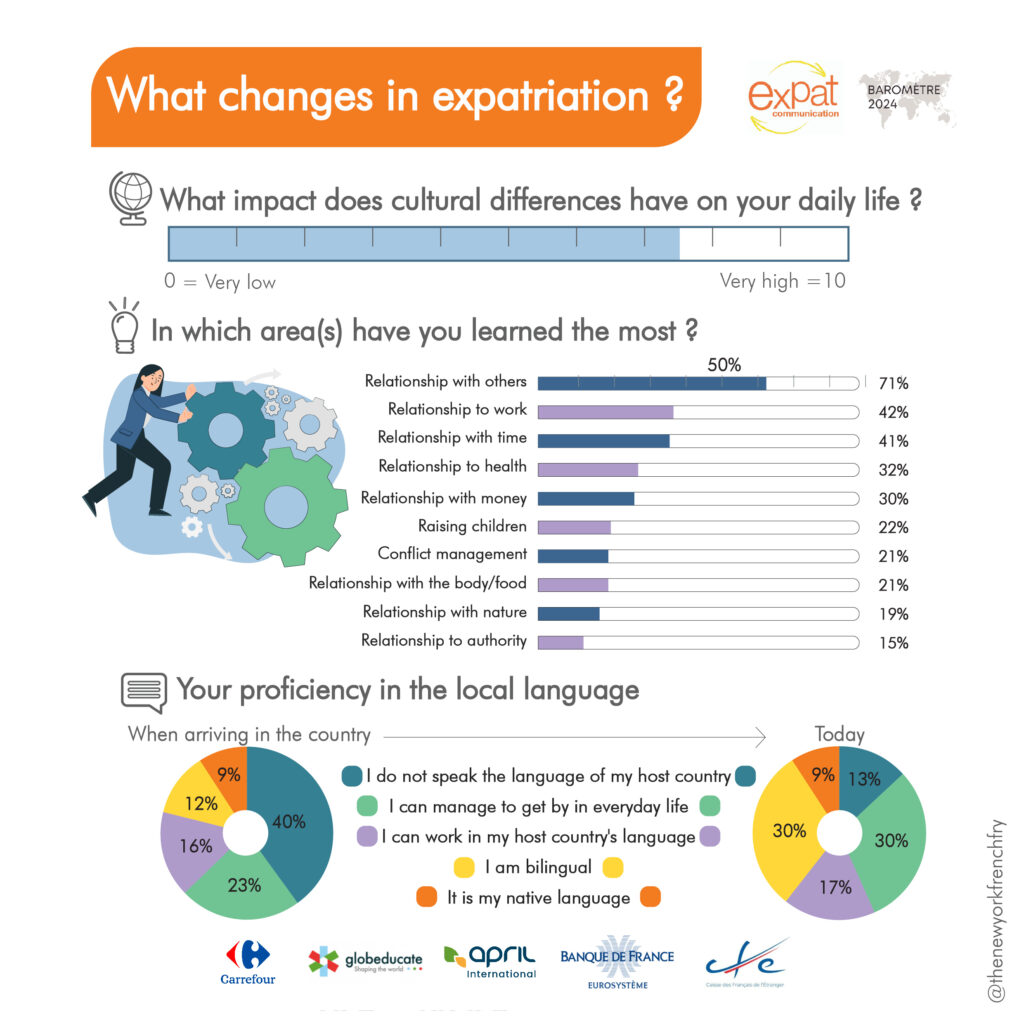
Even if exposure to different cultures is greatly facilitated, especially thanks to social networks, expatriation allows the most successful experience of meeting others, and questioning one’s role model. As the figures from the latest survey show, the relationship with others is by far the area where you learn the most when you live abroad (71%), followed by the relationship to work and the relationship to time.

The relationship to health/medicine is also questioned by the experience of expatriation (32%). This is a testament to the strong culture of care in France and the real shock that expats experience when they are confronted with other health cultures, which often have a much more commercial and much less universal approach than in France
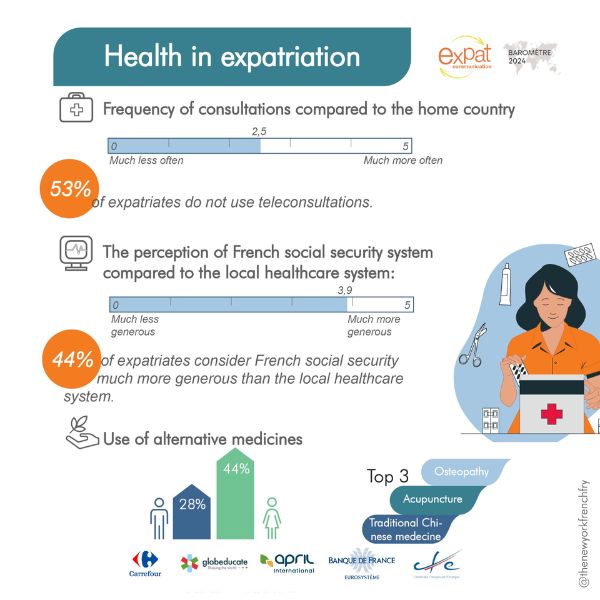
The perception of the French health system improves significantly when you live abroad. As for consultation habits, they do not vary so much in terms of frequency but rather in terms of the type of care/medicine sought.

Enquete 2 Baromètre Expat Communication44% of expats give a score of 5/5 when asked to rate the generosity of the French social security system compared to the local health system and the score of all respondents is 3.9/5.

While the frequency of consultations remains unchanged when living abroad (whether it is on-site consultations or teleconsultations, which, incidentally, concern only 47% of respondents), the use of alternative medicine still concerns more than a third of respondents, especially among women (44%).

Osteopathy is particularly popular, and unsurprisingly, Chinese medicine and acupuncture are popular in Asia (medicines 1.5 to 2 times more practiced by expatriates in this region than in the rest of the world).

Training remains above all a means of developing technical skills in one's professional field of activity. Spouses are the most numerous to follow expatriation training.

Enquete 2 Baromètre Expat Communication42% of respondents and 55% of spouses have followed an expatriation training, but with different objectives. The panel of respondents favours training to develop their field of expertise, while spouses promote learning the language of the country. Spouses are also twice as likely as the panel to follow training in the fields of teaching/FLE and coaching.

The culture of the diploma remains very present. The recognition of the diploma is the first criterion for selecting a training course or a course of study abroad.
Learning languages is also one of the great advantages of expatriation. The share of respondents who do not speak the language of the country at all has fallen by two-thirds thanks to their expatriation stay and the number of bilingual expatriates has tripled. As mentioned earlier, language training is the first training for spouses and the second for the entire panel.

Finally, only 29% of training courses are remote, down from 2021 (33%).

The challenges faced by expatriate employees are above all related to managing work/life balance and the ability to build trust.

A previous study by the barometer showed the increase in the mental load for expatriate employees and this is reflected in the difficulties encountered: more than a third of employees have difficulty reconciling professional and personal life.

“Building trust” in the workplace is also singled out as one of the major challenges for expatriate employees.

Enquete 2 Baromètre Expat Communication

Members of the Expat Communication Barometer.

Those who relay the Expat Communication Barometer.

Next survey on “Expat life” from July 5 to August 5, 2024.

About Expat Communication

Since 2001, Expat Communication has been preparing and supporting its clients’ expatriates and international teams.

Its mission: to identify and share the keys to a successful international experience through three business lines:

  • Expat Lab: benchmark studies on expatriates and international mobility. Barometer, conferences, masterclasses and publications.
  • Coaching and training: programmes to facilitate expatriation and strengthen employees’ intercultural intelligence, all over the world in 8 languages. These programmes are run by a network of trained and supervised intercultural coaches.
  • Expat Network: Club Expat Premium and the femmexpat.com website support more than 40,000 expatriates worldwide.

Join our panel

If you would like to have access to the infographics and survey results, join the Barometer Board or contact us via the link below for more information:

Follow-us

Request a quote

Please fill out the form below, or contact us directly at +33 (0)1 42 3 691 91 or by email at contact@expatcommunication.com

Your IM Manager

To join our team

Please fill out the form below, or contact us directly at +33 (0)1 42 36 91 91 or by email at recrutement@expatcommunication.com


We are at your disposal

from 9am to 6pm (CET) +33 (0)1 42 36 91 91

Write to us

Club Expat Premium subscription request

Please fill out the form below, or contact us directly at +33 (0)1 42 3 691 91 or by email at contact@expatcommunication.com

For each subscription, please indicate the number of expatriates concerned and their contact information (city, country, email + spouse's email if applicable). If you prefer, you can send us an Excel spreadsheet or contact us directly.