




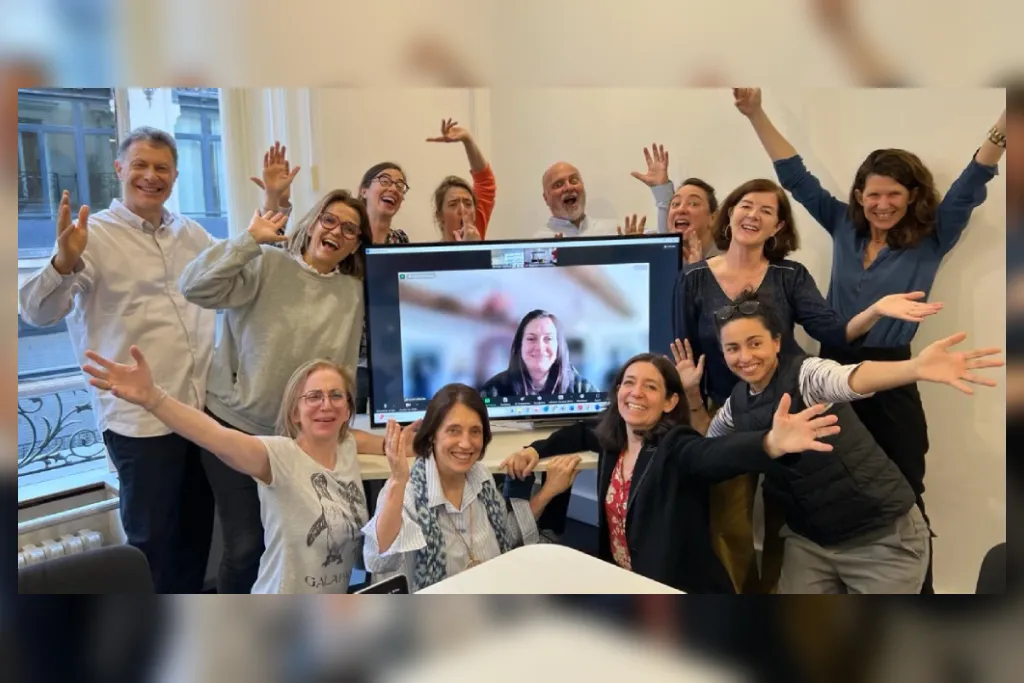

Intercultural Training: Collaborate and Lead More Effectively in a Globalized World
Expat Communication’s intercultural training programs help managers, teams, and internationally mobile employees turn cultural diversity into performance.
By understanding cultural differences and improving intercultural communication, your talents integrate more quickly, strengthen their cross-cultural relationships, and thrive in complex cultural environments.
Managers and International Teams: Our Solutions
Intercultural Management for Executives and Leaders
One-on-one coaching
- For: International managers
- Goal: Help leaders and executives turn intercultural complexity into a driver of managerial performance
Intercultural Communication (Level 1)
Group Training
- For: Teams working internationally
- Goal: Prevent cultural misunderstandings that hinder collective performance and efficiency through engaging awareness sessions for better teamwork.
Intercultural Team Cohesion (Level 2)
Group Training
- For: Multicultural teams
- Goal: Make projects succeed through better cross-cultural collaboration.
Supporting international mobility with a 360° approach.
From expatriates to HR teams, transform intercultural challenges into success levers.
Intercultural Intelligence for Expats
One-on-one coaching
- For: Expats and families
-
Goal: Accelerate integration and maintain performance in an international context
Masterclass Rosinski – Coaching & leadership
Group Training
- Audience: Coaches, managers, HR professionals
- Goal: Integrate cultural dimensions into leadership and coaching practices.
Managing Cultural Diversity in International Companies
Group Training
- Audience: HR professionals and international mobility managers
- Goal: Improve collaboration and support through intercultural management skills.
They say it better than we do
“In three years, our company was bought by Americans and then merged with a German team. The intercultural training helped us identify our differences and establish common ground.”

“The seminar we organized with Expat Communication for the entire global HR function was a decisive step in getting to know each other better, building connections, and improving the way we work together. As an HR officer, I found in these methods a real lever to facilitate integration within our international offices.”

“On our project, between the clients, service providers, and my team, there were at least 15 different nationalities—including many Egyptians, Lebanese, and of course French. We were no longer understanding each other, and it was jeopardizing the project’s success. The coaches helped us realize that each of us came with our own assumptions, which could clash with others. In just two days, we laid the foundations for a more harmonious collaboration within the team and with the client.”

“Relations with our Indian partner were becoming increasingly strained. With the coaches, we mainly worked on identifying common ground and building synergies. The collaboration remains challenging, but we are now better at spotting issues and have a method to defuse them.”

Intercultural Management: Common Challenges and Our Solutions
| ❌ Difficultés rencontrées | ✅ Nos accompagnements |
|---|---|
| Malentendus dans des équipes à distance ou sur site | Formation à la communication interculturelle et aux cultures différentes |
| Tensions liées à la gestion de la diversité culturelle | Ateliers collaboratifs et sensibilisation à la place de chacun |
| Radicalisation des opinions et blocages relationnels | Approche neutre, respectueuse et structurée autour de la laïcité et du vivre-ensemble |
| Risque de réputation ou d'échec de mission | Coaching et préparation des collaborateurs et de leurs organisations |
| Perte de repères dans les relations hiérarchiques ou commerciales | Décryptage des rôles, usages et styles de management selon les pays. |
Why Invest in Intercultural Training?
In a globalized world, the value of intercultural training goes far beyond simple awareness.
It enables people from diverse backgrounds to collaborate more effectively, strengthen their professional lives, and even improve personal and family well-being during expatriation.
With proper support, employees can transform culture shock into positive change:
- A better work–life balance for expatriates and their families.
- Faster and better decision-making through clearer understanding of cultural factors.
- A genuine lever for personal development that also fuels collective performance.
Every international mobility project thus becomes an opportunity for sustainable growth—for both the company and the individual.
Want to turn cultural diversity into a driver of success?
Key statistics
of international mobility expertise
Of 8 nationalities in 20 countries
Those who received training in 2025 recommend
Collected from participants in 2025
Process for tailored-made programs :
1
Analysis of the company's needs followed by an interview with the participant.
2
Proposal of a customized program.
3
Implementation of sessions, online or in-person
4
Monitoring and personalized evaluation.
Frequently Asked Questions
How long do your programs last?
The duration is tailored to the company’s objectives and the availability of employees.
Are they delivered in person or online?
Les deux sont possibles. Les ateliers peuvent se dérouler dans nos locaux ou ceux de votre entreprise. It can also be organized online.
In which language is the training conducted?
Our intercultural management workshops can be conducted in English or French.
In which language is the training conducted?
The label “Qualiopi” from the French Labor Ministry ensures the quality of our services.
Expat Communication certified provider for Région Ile de France Platform.
Would you like to discuss this with an expert?