
When discussing the return from expatriation with international mobility and HR professionals, the expression "sea serpent" often comes up. While for expatriates, the image of the ostrich appears frequently.
These two metaphors imply three ideas:
- A feeling of vagueness, unreality, even denial.
- A feeling of powerlessness in the face of risk.
- And the inexorable return of this problem.
However, the return from expatriation is a crucial step in the international mobility process. It is therefore necessary to go beyond this vagueness and identify strategies to circumscribe the risk. Because, good news, most of the necessary elements are now available.

Lorsque l’on évoque le retour d’expatriation avec les professionnels de la mobilité internationale et des RH, c’est souvent l’expression « serpent de mer » qui fait surface. Alors qu’avec les expatriés, l’image de l’autruche surgit invariablement.
Pourtant, comme le souligne Ludivine Requena de Carrefour, « le retour fait partie intégrante de d’expatriation et appartient donc au champ d’action de la mobilité internationale ». Karim Kouicem, de BNP Paribas renchérit en rappelant qu’il s’agit « de permettre que la mobilité internationale reste une démarche attractive et valorisante. »
Un enjeu crucial donc mais qui demeure largement négligé.
Voici donc 4 clés pour faciliter l’accompagnement du retour !
01
Data on the return from expatriation exists
Since 2014, the Expat Communication Barometer (link) has produced data and analysis on return.
And for the past 8 years, all the results converge: the return is the most critical phase of international mobility. At issue:
- From the expatriate’s point of view, the lack of recognition of their experience, the feeling of isolation, the administrative complexity.
- Seen from the companies, the absence of an entity responsible for the management of the return, an inappropriate posture of the expatriate.
The Expat Communication 2022 barometer reveals two other issues:
- Lack of perception of the risk of return. 70% of returning expatriates feel that this last phase was difficult. On the other hand, expatriates still living abroad do not perceive this risk, with 38% saying they are concerned. As their return is not scheduled, they do not anticipate it. In companies, apart from those involved in international mobility, this denial is widely shared.
- The lack of support in the companies during this phase. As return is not perceived as a critical issue, return support mechanisms remain limited or even non-existent.

2. Les principales difficultés du retour sont la baisse du niveau de vie, l’impression que l’expatriation n’est pas valorisée et la solitude.
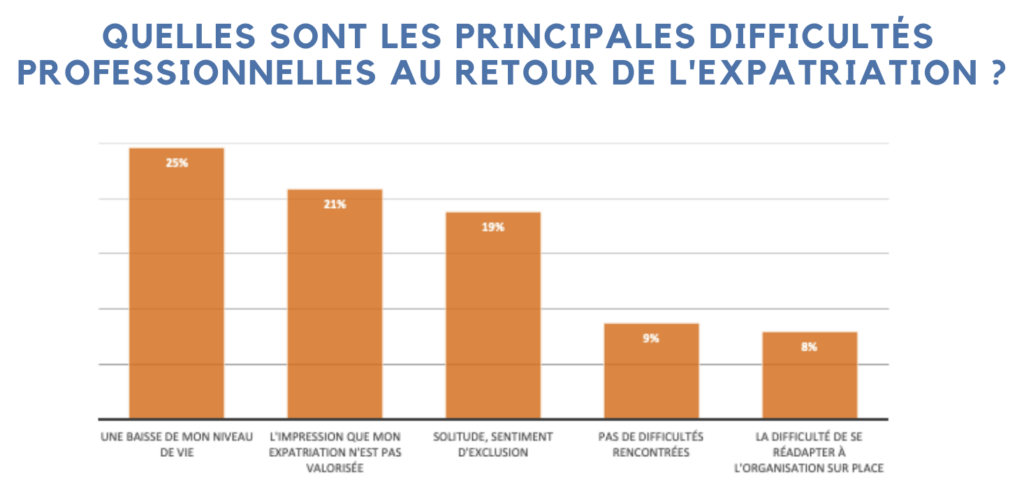
3. L’absence de perception du risque du retour. Les expatriés en poste ne perçoivent pas ce risque et seuls 38% s’en disent inquiets. Et pour ceux dont le retour n’est pas programmé, à quoi bon l’anticiper !
Les intervenants ont ensuite précisé les difficultés liées aux décalages du retour. Ludivine Requena insiste sur la perte de repères du collaborateur venu d’une filiale face aux codes du siège, ainsi que sur l’adaptation de la famille, notamment du conjoint, sommé de reprendre rapidement une activité professionnelle.
Karim Kouicem le décalage de visibilité et de champ de responsabilités parfois ainsi que de cadre de vie.
Delphine Renard, coach chez Expat Communication, témoigne de la frustration des expatriés qui cherchent à partager leur expérience et à lui donner du sens dans leur nouvelles fonctions alors même que leur aptitude à interagir dans le contexte du siège s’est émoussée.
02
Good practices are identified, but not widely applied.
There is a consensus on practices that facilitate the return of expatriates.
First of all, the success of the return is determined from the start. Preparation and information play a crucial role until the end of the expatriation. However, after the upheaval linked to the epidemic and the evolution of the forms of international mobility, these services tend to be less solicited today.
Then, in the year preceding the expatriate’s return, the Talent and International Mobility Departments work together effectively to ensure that the expatriate finds a position that makes the most of his/her international experience.
Finally, expatriates must adapt their posture and expectations in order to facilitate their integration and to become an actor in the valorization of their experience abroad. Coaching or training upon return significantly favors this attitude but companies rarely use it, mainly for process reasons.
In sum, the improvement of the return is not based on one action but on a set of measures.
Par ailleurs, le retour des expatriés est confronté à un effet de structure RH car les expatriés reviennent au niveau où la pyramide hiérarchique se rétrécit. C’est le moment où le réseau et l’influence se révèlent cruciaux. Les expatriés ne se trouvent donc pas en position de force dans cette compétition.
03
An efficient process to progress on the way back
The companies that have succeeded in moving from rhetoric to action generally have in common that they have adopted a systemic approach:
- They considered the process from departure to return
- They involved all actors: expatriates, talents and IMs, management, transferring entity and returning entity.
- They examined the stakes and not only the processes, explicitly formulating the gains, the price to be paid and the commitments of each of the actors, thus leading to a consensual and realistic action plan.
- With the HR experts of its Coach Academy, Expat Communication can accompany your company in this diagnostic and improvement process.
- Diagnosis (quantitative: barometer, and qualitative: focus group) and MI consulting.
- Preparation for expatriation
- Accompaniment throughout the expatriation and progressive awareness of the return with the Club Expat Premium
- Coaching for returning expatriates.
Un process efficace pour progresser sur le chemin du retour
Les entreprises qui ont réussi à sortir de l’incantation et à passer à l’action ont généralement en commun d’avoir adopté une démarche complète :
- Elles ont considéré le process depuis le départ jusqu’au retour
- Elles ont impliqué tous les acteurs : expatriés, talents et MI, management, entité cédante et entité de retour en anticipant les mouvements.
- Elles ont examiné les enjeux et non pas seulement les process, formulant de façon explicite les gains, le prix à payer et les engagements de chacun des acteurs, aboutissant ainsi à un plan d’action consensuel et réaliste.
04
Aider l’expatrié à piloter son retour
Comme l’a souligné Ludivine Requena, la mobilité internationale peut jouer le rôle de facilitateur, mais, in fine, c’est à l’expatrié de piloter sa propre carrière. Cependant pour cela il s’avère nécessaire de l’outiller.
Avec les experts RH de sa Coach Academy, Expat Communication peut accompagner votre entreprise dans cette démarche de diagnostic et d’amélioration.
- Diagnostic (quantitatif : baromètre, et qualitatif : focus group).
- Préparation à l’expatriation puisqu’on l’a vu, le succès du retour se joue dès le départ. Découvrir nos services de préparation à l’expatriation.
- Accompagnement tout au long de l’expatriation et sensibilisation progressive au retour avec le Club Expat Premium (Newsletters hebdomadaires, articles, ateliers, coachings).
- Coaching pour les expatriés de retour et pour leurs conjoints, sur les aspects carrières, pro et perso. Découvrir nos accompagnements pour le retour.
Parent pauvre de la mobilité internationale, l’accompagnement du retour devrait s’imposer comme un thème majeur dans le contexte de guerre des talents actuel car comme l’affirmait Karim Kouicem, il est un facteur crucial de rétention de talents clés. Et Ludivine Réquena de renchérir pour conclure en rappelant que parmi les expatriés se trouvent nos dirigeants de demain. C’est au retour qu’il faut les accompagner pour ne pas les perdre.
Together we care for international talents !
Expat Communication
Expert in interculturality and coaching
for international talent since 2001.